Analysis of Change in Graphic Organizers

Subject A: Analysis of Change in Graphic Organizers
Subject A showed significant change in his ability to organize and develop ideas in his graphic organizers. For the initial assessment, Subject A did not create a graphic organizer. In his rough graphic organizer for Writing Task 1, Subject A presented a central idea or thesis that was too broad, citing the main topic as “my admiration for my friend Devon. His strengths and weaknesses.” This thesis allows for too much information to be included in the main body, which led to reader confusion. Also, the supporting ideas illustrated in the rough graphic organizer for Writing Task 1 were broad and reflected the unfocused central idea. The first body paragraph idea states that Devon is generous but the supporting details did not all support this idea. The essay listed information about how the two friends met, how they can’t spend time face to face, as well as a supporting explanation for how Devon is generous. The second body paragraph idea did not support the central idea of Subject A’s admiration for his friend. Instead it stated that Devon has problems or flaws. The third body paragraph was focused and presented Devon’s sense of humor as a strength. The details listed under “sense of humor,” however, were broad and could become supporting ideas themselves. For example, “love his sense of humor” is listed as a supporting detail.
After teacher feedback, the final graphic organizer showed a central idea that was more focused. Devon’s weaknesses have been eliminated from the thesis and the focus was on his strengths. Each supporting idea illuminated a major strength and the supporting details helped develop these ideas. For example, under the idea “Devon is really caring,” Subject A listed that Devon “wants to support his mom in case she can’t in the future.” For the second supporting idea, Subject A stated that “Devon uses his problems to fuel his movement forward.” He then went on to state that “Devon’s worries about financial security fuel his school work.” The final graphic organizer illustrated Subject A’s better grasp of organization and idea development.

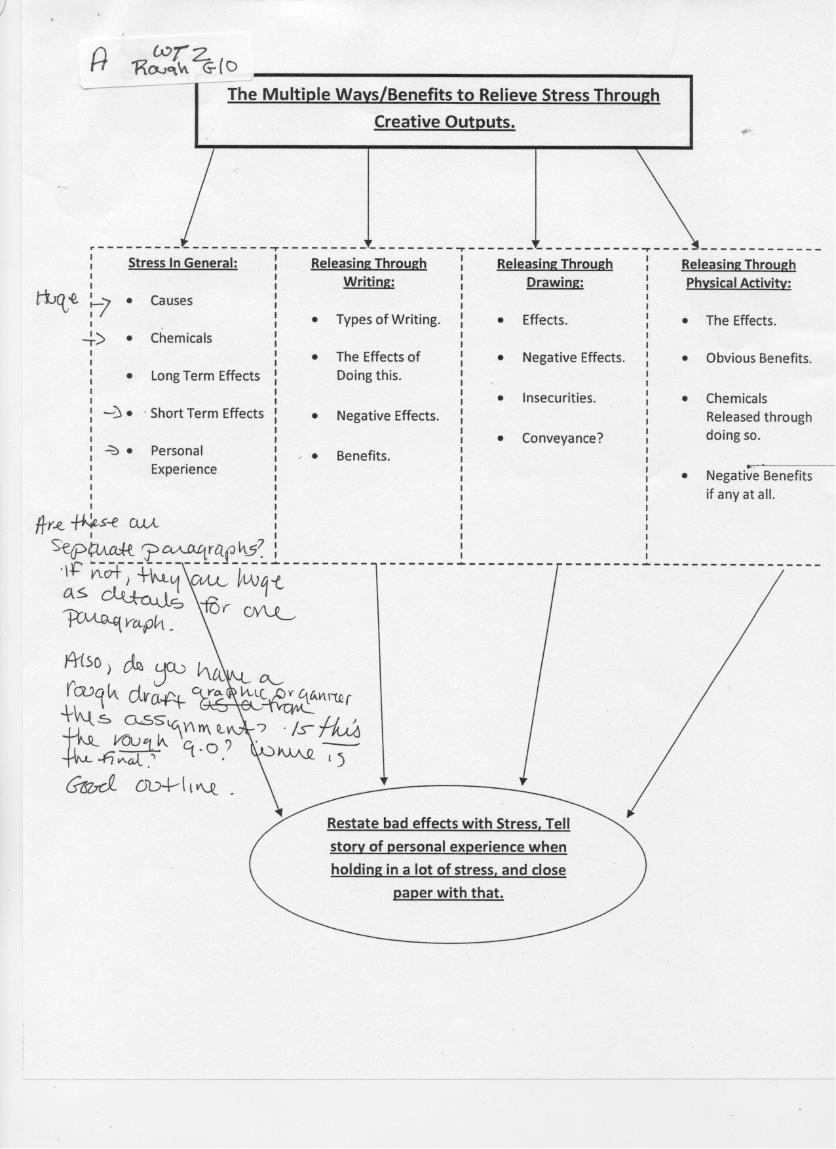
Subject A also showed significant change in the graphic organizers he created for Writing Task 2. The rough draft of his graphic organizer was well organized with most ideas supporting a clear thesis and succinctly presented. The thesis idea for this composition was “The multiple ways/benefits to relieve stress through creative outputs.” While the first supporting idea paragraph was a bit broad with a focus on “stress in general,” the others each were clearly defined. The second paragraph focused on writing as a release, the third focused on drawing as a release, as well as on physical activity. The supporting details for the supporting idea paragraphs were a bit broad too but did more clearly align with their ideas and develop them. The final draft of the graphic organizer was arranged more like an outline, however the ideas were clear and took teacher feedback into account. The subconcepts also had changed and the central idea focused on the signs of stress rather than the ways to relieve stress. The first body paragraph had as a heading “the cognitive symptoms” of stress. Supporting details for this idea were more specific and included “memory problems, inability to concentrate, and poor judgment. The other paragraphs focused on “emotional symptoms, physical symptoms and behavioral symptoms.”

Subject A also showed significant change in the graphic organizers he created for Writing Task 2. The rough draft of his graphic organizer was well organized with most ideas supporting a clear thesis and succinctly presented. The thesis idea for this composition was “The multiple ways/benefits to relieve stress through creative outputs.” While the first supporting idea paragraph was a bit broad with a focus on “stress in general,” the others each were clearly defined. The second paragraph focused on writing as a release, the third focused on drawing as a release, as well as on physical activity. The supporting details for the supporting idea paragraphs were a bit broad too but did more clearly align with their ideas and develop them. The final draft of the graphic organizer was arranged more like an outline, however the ideas were clear and took teacher feedback into account. The subconcepts also had changed and the central idea focused on the signs of stress rather than the ways to relieve stress. The first body paragraph had as a heading “the cognitive symptoms” of stress. Supporting details for this idea were more specific and included “memory problems, inability to concentrate, and poor judgment. The other paragraphs focused on “emotional symptoms, physical symptoms and behavioral symptoms.”

For Writing Task 3, Subject A again created a rough graphic organizer that contained a strong central idea with a thesis that focused on the evaluation of the movie Scott Pilgrim vs. the World. His central idea was that it is a “great, fun movie that is cohesive to the storyline portrayed in the books, but he doesn’t spend too much time giving details to the point where it works.” Though a bit lengthy and overly detailed, the thesis was strong enough to allow the rest of the ideas and details to support it. Body paragraph one discussed the hype, promise, and delivery, which was a bit broad and could be reworded to a narrower subject. Body paragraph two focused on character development. One more supporting idea would have strengthened the essay frame. Unfortunately, Subject A did not revise and finalize a draft of his graphic organizer for Writing Task 3, so data are not available. However, it is clear from those organizers that he did complete, that Subject A became more adept at organizing and developing his ideas in the form of a graphic organizer. Teacher feedback and revision shows further understanding of the planning process.

For his final assessment, Subject A created a graphic organizer in the form of a web. It contained a clear central idea that stated that “Choices are a bad thing usually.” The subconcepts did branch off from the main idea, and the main idea was easily recognizable. While the subconcepts could have been more logically arranged to illustrate the hierarchical nature of the ideas, the subconcepts are identifiable. For example, he stated that variety is “good but overwhelming,” and that choices leave “room for doubt.”

Although he was not consistent in his use of graphic organizers, the final drafts of Subject A’s graphic organizers for the writing tasks became more organized and contained more relevant and thorough content after he received teacher feedback on the rough drafts. His writing was impacted by the development of graphic organizers as well.
Subject B: Analysis of Change in Graphic Organizers
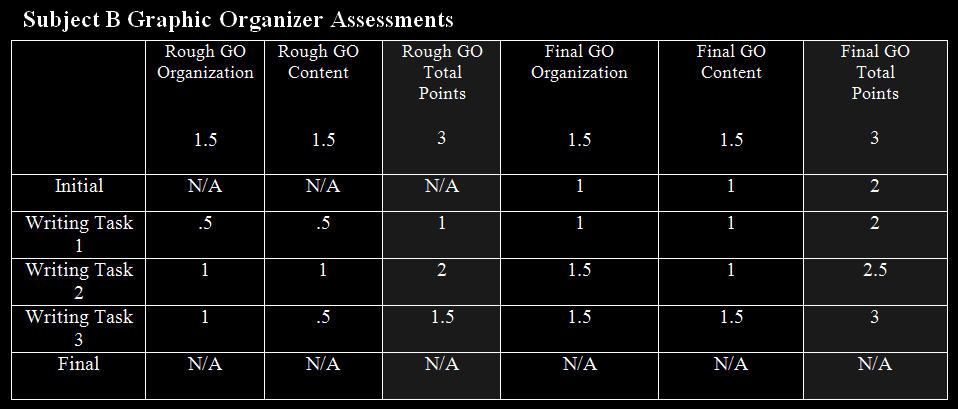
Subject B did not create a graphic organizer in the final assessment and thus did not demonstrate change in organization or idea development in these two assessments. However, in each of the writing tasks throughout the study, Subject B showed significant change as she moved from the rough drafts of her graphic organizers to the final drafts, especially for Writing Tasks 1 and 3. Teacher feedback and the drafting process enhanced comprehension of organization and idea development in graphic organizers. Also, in comparison to the graphic organizer created for her initial assessment, graphic organizers for each of the three writing tasks became more detail-oriented and worked to show more clearly the central idea and the relationships between subconcepts and the central idea. The essential information in the graphic organizers for the writing tasks also illustrated clearer more logical arrangement.
By the end of the study, Subject B demonstrated that teacher feedback and the drafting and revision process were effective in helping her to become more organized and to develop ideas more thoroughly. However, she had not yet become able to independently utilize the planning and prewriting strategies from her course work and needed continued emphasis on these.
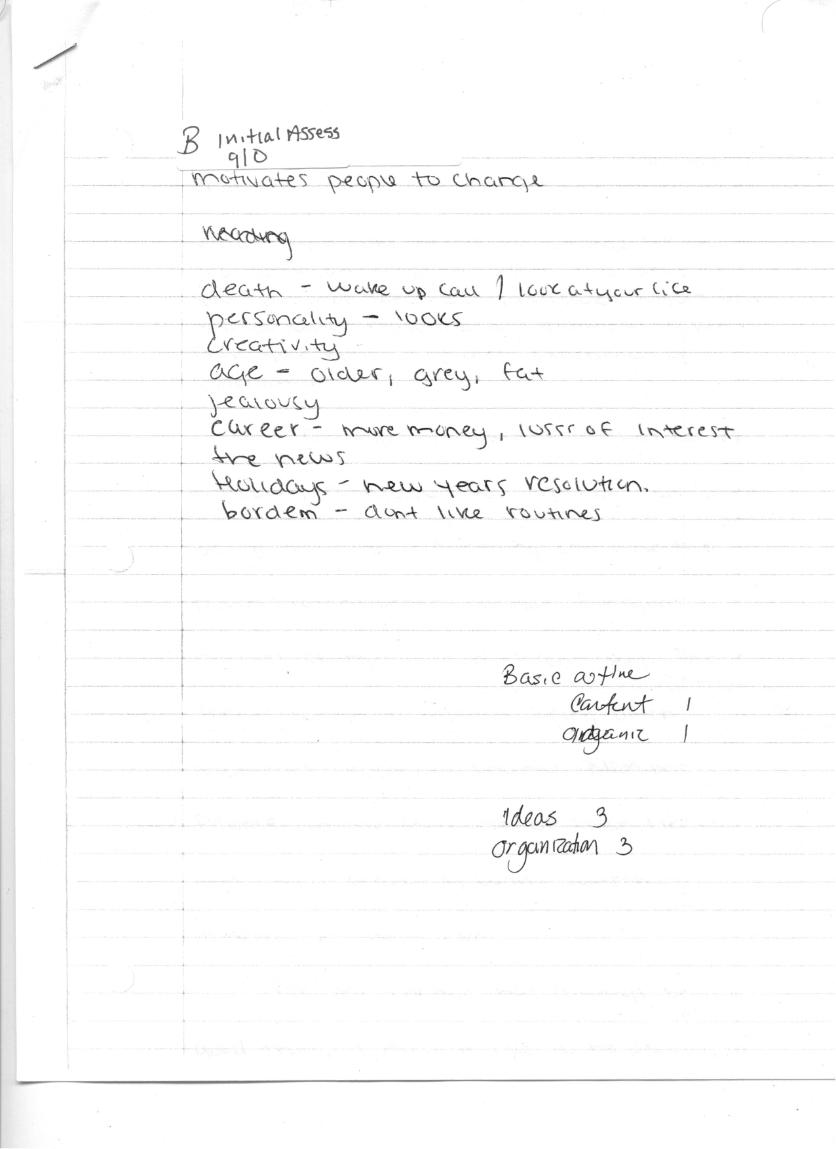
In her initial assessment, Subject B created a list of subconcepts for her thesis idea and listed more specific supporting details beside these subconcepts. This initial graphic organizer showed the relationship between the main concept and the subconcepts and contained some essential information. However, the central idea was broad and undefined, and the subconcepts could have used more development through the citation of specific supporting details. For example, in response to the prompt asking students to explain what it is that motivates people to change, Subject B simply stated as her central idea, “motivates to change.” Underneath this phrase were the words “death” and then “wake up call/look at your life.” This worked as a subconcept to support the idea that experiencing a death can motivate people to change. If two or three details supporting this subconcept were listed beneath the word “death,” the graphic organizer would have been more complete. Also, after this initial idea at the top of the list, the other subconcepts were not complete ideas and did not have supporting information to help clarify them. For instance, “personality” was on the list but it was unclear how “personality” might motivate someone to change. Also, the only other idea beside the word “personality” was “looks.” It is unclear what this might mean in relation to “personality.” Each of the items on the list of subconcepts should have been in phrase format to help with clarity.
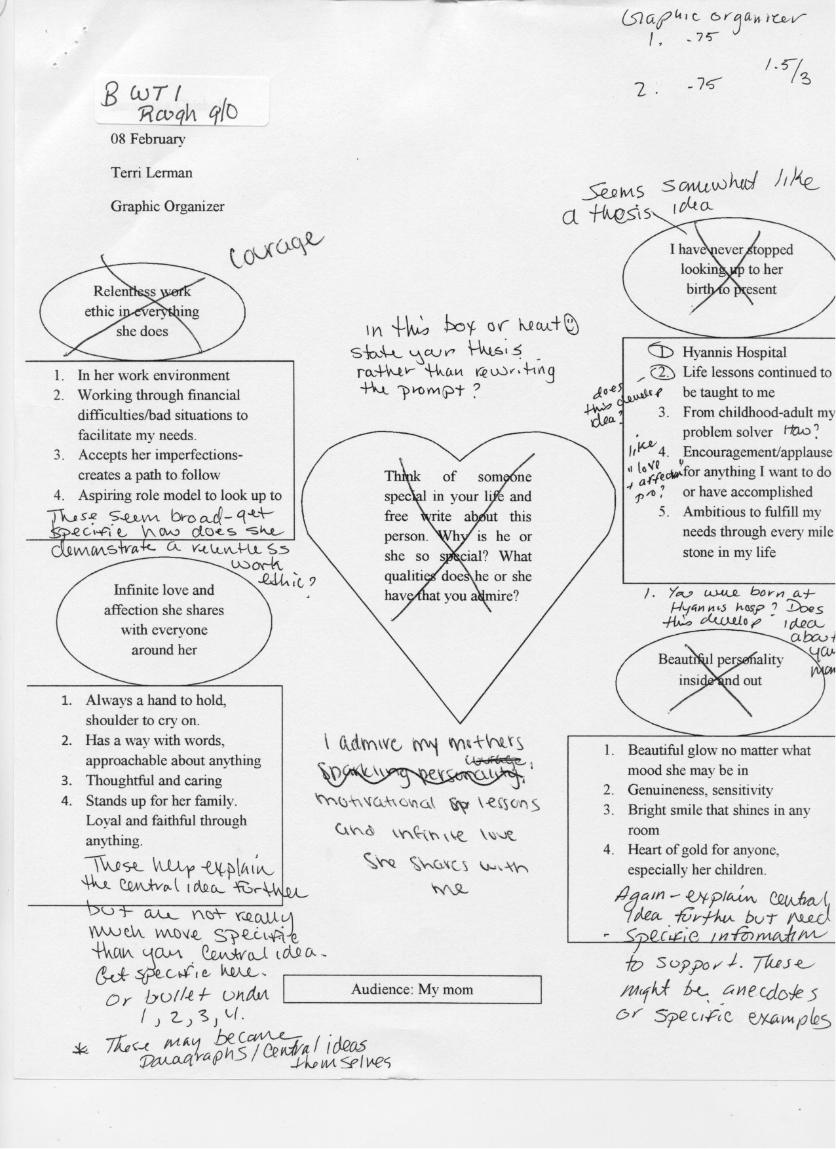
After receiving written feedback and conferencing with the teacher about the rough graphic organizer, Subject B made revisions that clarified the ideas and their relationships to one another. The central idea was written at the top of the page instead of the writing prompt and, while in some instances the supporting details could have still been more specific, in the final organizer most of them were more focused. Also, the central idea and subconcepts were clearer and more succinct. For example, under the subconcept of “strength,” Subject B created another category for “working” and then placed specific details such as the fact that her mother works “behind the bar double hours” and “Home to vacuum, clean house, and place meals on the table.”
