Summary of Findings for Each Student by Type: Metacognitive Awareness Inventory
Subject A: Metacognitive Awareness Inventory
Subject A scored 7 points on declarative knowledge, 2 points on procedural knowledge, and 5 points on
conditional knowledge for a total score of 13 points for knowledge about cognition. He received 3 points for
planning, 8 pointsfor information management, 3 points for comprehension monitoring, 5 points for
debugging strategies, and 4 points for evaluation strategies for a total of 23 points for regulation of cognition.
Subject A received a total of 36 points on the Metacognitive Awareness Inventory during the initial
assessment.
On his final assessment, Subject A scored 8 points on declarative knowledge, 4 points on procedural
knowledge, and 5 points on conditional knowledge for a total of 17 points. He received 7 points for planning,
10 points for information management, 7 points for comprehension monitoring, 5 points for debugging
strategies, and 6 points for evaluation strategies for a total of 35 points for regulation of cognition. Subject A
scored a total of 52 points on the Metacognitive Awareness Inventory during the final assessment.

Discussion of Change in Subject A: Metacognitive Awareness Inventory
Subject A showed change in both knowledge about cognition and regulation of cognition, increasing by
two points in procedural knowledge, one point in declarative knowledge, one point in conditional knowledge.
He gained four points in planning, two points in information management, two points in evaluation, and
twelve points in regulation of cognition.
Subject B: Metacognitive Awareness Inventory
On her initial assessment, Subject B received 6 points for declarative knowledge, 3 points for procedural
knowledge, and 4 points for conditional knowledge for a score of 13 points in knowledge about cognition.
Subject B received 3 points for planning, 8 points for information management, 6 points for comprehension
monitoring, 5 points for debugging strategies, and 1 point for regulation of cognition, for a total of 23 points
for regulation of cognition and an overall initial score of 36 points.
On her final assessment, Subject B received 6 points for declarative knowledge, 3 points for procedural
knowledge, and 4 points for conditional knowledge for a score of 13 points in knowledge about cognition. In
the category of regulation of cognition, Subject B received a total of 34 points with 2 points for planning, 9
points for information management, 4 points for comprehension monitoring, 4 points for debugging strategies,
and 2 points for evaluation strategies.

Discussion of Change in Subject B: Metacognitive Awareness Inventory
Subject B showed no significant change in metacognition. Each category remained the same and she
received fewer points in comprehension monitoring and regulation of cognition on the final assessment than on
the initial assessment.
Subject C: Metacognitve Awareness Inventory
Subject C scored 7 points on declarative knowledge, 3 points on procedural knowledge, and 4 points on
conditional knowledge for a total score of 14 points for knowledge about cognition. She received 4 points for
planning, 5 points for information management, 7 points for comprehension monitoring, 4 points for
debugging strategies, and 5 points for evaluation strategies, for a total of 25 points for regulation of cognition.
Together, Subject C scored a total of 39 points on the Metacognitive Awareness Inventory during the initial
assessment.
On her final assessment, Subject C scored 6 points on declarative knowledge, 3 points on procedural
knowledge, and 3 points on conditional knowledge for a total of 12 points. She received 4 points for planning,
9 points for information management, 5 points for comprehension monitoring, 5 points for debugging strategies,
and 4 points for evaluation strategies for a total of 27 points for regulation of cognition. Together, Subject C
scored a total of 39 points on the Metacognitive Awareness Inventory during the final assessment.

Discussion of Change in Subject C: Metacognitive Awareness Inventory
Subject C showed no significant change in metacognition overall. However, she increased her score
significantly in the area of information management, scoring 5 points initially and then 9 points in the final
assessment.
Subject D: Metacognitive Awareness Inventory
For the initial Metacognitive Awareness inventory assessment, Subject D was not present and his data
was not collected later. On his final assessment, Subject D scored 8 points on declarative knowledge, 4 points
on procedural knowledge, and 5 points on conditional knowledge for a total of 17 points. He received 5
points for planning, 9 points for information management, 7 points for comprehension monitoring, 5 points
for debugging strategies, and 4 points for evaluation strategies for a total of 30 points for regulation of
cognition. Together, Subject D scored a total of 52 points on the Metacognitive Awareness Inventory during
the final assessment.

Discussion of Change in Subject D: Metacognitve Awareness Inventory
Subject D was not present when the initial Metacognitve Awareness Inventory was given and data went
inadvertently uncollected. Thus, change cannot be measured.
Subject E: Metacognitve Awareness Inventory
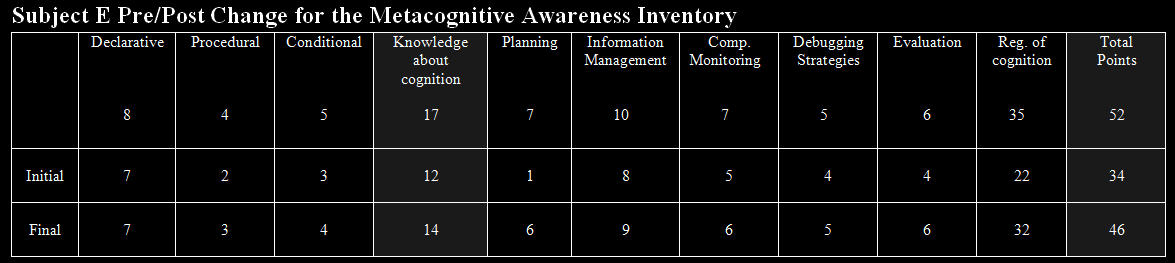
On his initial assessment, Subject E received 7 points for declarative knowledge, 2 points for procedural
knowledge, and 3 points for conditional knowledge for a score of 12 points in knowledge about cognition.
Subject E received 1 point for planning, 8 points for information management, 5 points for comprehension
monitoring, 4 points for debugging strategies, and 1 point for evaluation strategies for a total of 22 points for
regulation of cognition and an overall initial score of 34 points.
On his final assessment, Subject E received 7 points for declarative knowledge, 3 points for procedural
knowledge, and 4 points for conditional knowledge for a score of 14 points in knowledge about cognition. In
the category of regulation of cognition, Subject E received a total of 46 points with 6 points for planning, 9
points for information management, 6 points for comprehension monitoring, 5 points for debugging strategies,
and 6 points for evaluation strategies.
Discussion of Change in Subject E: Metacognitive Awareness Inventory
Subject E showed change in metacognition, especially in planning strategies within the category of
regulation of cognition. He increased five points in regulation of planning strategies and two points in
regulation of evaluation.
Subject F: Metacognitive Awareness Inventory
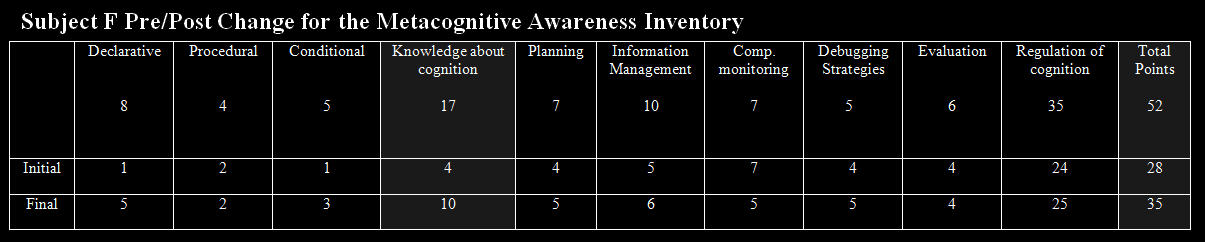
Subject F scored 1 point on declarative knowledge, 2 points on procedural knowledge, and 1 point on
conditional knowledge for a total score of 4 points for knowledge about cognition. She received 4 points for
planning, 5 points for information management, 7 points for comprehension monitoring, 4 points for
debugging strategies, and 4 points for evaluation strategies, for a total of 24 points for regulation of cognition.
Together, Subject F scored a total of 28 points on the Metacognitive Awareness Inventory during the initial
assessment.
On her final assessment, Subject F scored 5 points on declarative knowledge, 2 points on procedural
knowledge, and 3 points on conditional knowledge for a total of 10 points. He received 5 points for planning, 6
points for information management, 5 points for comprehension monitoring, 5 points for debugging strategies,
and 4 points for evaluation strategies for a total of 25 points for regulation of cognition. Together, Subject F
scored a total of 35 points on the Metacognitive Awareness Inventory during the final assessment.
Discussion of Change in Subject F: Metacognive Awarness Inventory
Subject F showed change in declarative knowledge in the broader category of Knowledge About
Cognition. He gained four points in declarative knowledge and two points in conditional knowledge. In the
his regulation of cognition he gained one point in debugging strategies and one point in information
management. He lost two points in comprehension monitoring. Overall, Subject F gained seven points in
metacognitive awareness.
